
Aviation&Space
Rolls-Royce Trent 1000 engines signed the flight using completely sustainable aviation fuel

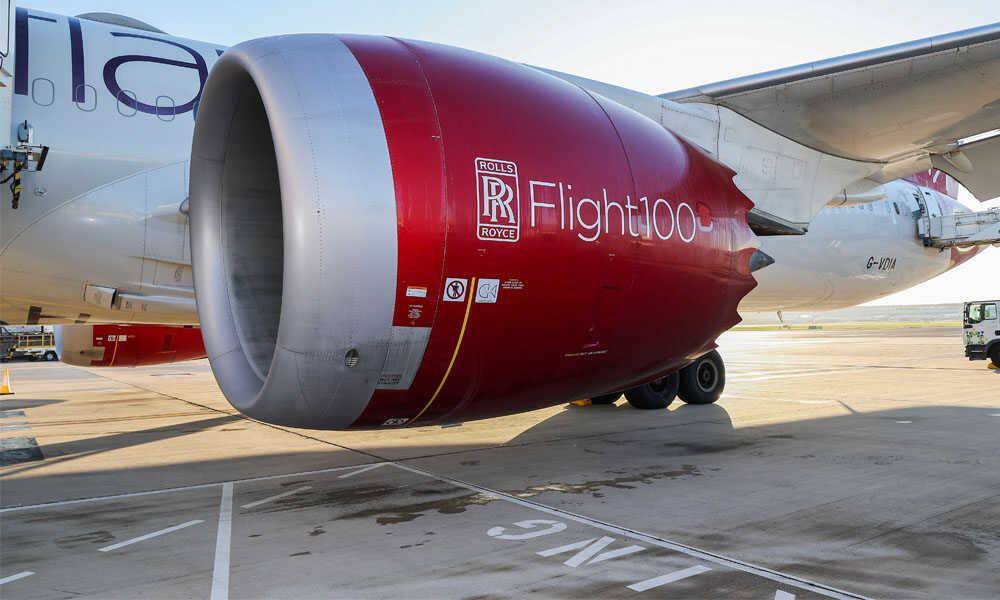
Rolls-Royce has announced that Virgin Atlantic’s historic 100% Sustainable Aviation Fuel (SAF) flight, Flight100, took off from London Heathrow to New York JFK, and that the flight will be powered by SAF’s fossil fuel, compatible with today’s engines, airframes and fuel infrastructure. announced that it was realized as a result of a year-long collaboration with the aim of demonstrating its potential as a safe substitute fuel that can replace derived jet fuel.
The flight, carried out with a Boeing 787 using Rolls-Royce Trent 1000 engines, was a first in the world when a commercial airline crossed the Atlantic with 100% SAF. This landmark flight was achieved by a consortium led by Virgin Atlantic, comprising Boeing, Rolls-Royce, Imperial College London, the University of Sheffield, ICF and the Rocky Mountain Institute, in partnership with the UK Department for Transport.
SAF plays a key role in decarbonising long-haul air travel and on the path to Net Zero 2050.
While other technologies such as electricity and hydrogen are expected to take several decades to become viable, SAF is available immediately. Today, SAF accounts for less than 0.1% of global jet fuel volume. Additionally, current fuel standards only allow a 50% SAF blend in commercial jet engines. Flight100 says the difficulty in scaling production is a policy and investment issue; It will prove that industry and government need to act quickly to create a thriving UK SAF industry.
The impact of SAF on in-flight non-carbon emissions will also be evaluated
Supported by consortium partners ICF, Rocky Mountain Institute (RMI), Imperial College London and the University of Sheffield, Flight100 will not only showcase the SAF’s capabilities but also assess its impact on non-carbon emissions during flight. This research will help advance the scientific understanding of the effects of SAF on tail wake and particles and apply tail wake predictions in the flight planning process. Data and research will be shared within the industry, and Virgin Atlantic will continue its involvement in tailrace research through RMI’s Climate Impact Taskforce, which is partly funded by Virgin Unite.
The SAF used on Flight100 consists of a proprietary blend: 88% HEFA (Hydroprocessed Esters and Fatty Acids) supplied by AirBP and 12% SAK (Synthetic Aromatic Kerosene) supplied by Marathon Petroleum Corporation subsidiary Virent. HEFA is derived from waste oils, while SAK is produced from plant sugars and the remaining components – plant proteins, fat and fibers – continue into the food chain. SAK is a component required in 100% SAF mixtures to deliver the necessary aromatics to the fuel for engine operation. Achieving Net Zero 2050 requires continuing the research and development required to bring new zero-emission aircraft to market, as well as making the innovation and investment needed across all available raw materials and technologies to maximize SAF volumes.
Rolls-Royce also fulfilled its 2021 commitment
Rolls-Royce recently announced that it has proven that all civil aviation engine types in production are 100% SAF compliant. Thus, Rolls-Royce fulfills its commitment in 2021 to demonstrate that there are no engine technology obstacles to the use of 100% SAF.
Virgin Atlantic CEO Shai Weiss said the following on the subject:
“The Flight100 flight proves that Sustainable Aviation Fuel can be used safely to replace fossil-derived jet fuel and is the only viable solution for decarbonising long-haul aviation. It has taken significant collaboration to get to this point, and we are proud to have reached this important milestone, but we need to go further. Current SAF supply is insufficient, large-scale production requires serious investments. This can only be achieved with regulations and price support mechanisms supported by the government. Flight100 emphasizes its commitment of ‘If you build it, we fly it’.”
Richard Branson, Founder of Virgin Atlantic, said:
“The world often assumes something is impossible until someone proves the contrary. The spirit of innovation includes trying to show that we can do better things for the benefit of everyone. Since 1984, Virgin Atlantic has persistently challenged convention, challenging the aviation industry to never settle and always strive for better. Almost 40 years later, this pioneering spirit remains the beating heart of Virgin Atlantic, pushing boundaries from carbon fiber aircraft to fleet upgrades and sustainable fuels. Today we meet with teams at Virgin Atlantic and partners working together to chart the course to decarbonise long-haul aviation.
I am proud to be at Flight100 with our bees.”
UK Transport Secretary Mark Harper said:
“The flight, operated with 100% SAF, shows how we can decarbonise transportation both now and in the future by reducing life cycle emissions by 70% and inspires next-generation solutions. Our government supported the flight, supporting the UK’s thriving SAF industry; “We will continue to support it to create jobs, grow the economy and bring us to the Jet Zero target.”
Simon Burr, Rolls-Royce Civil Aviation Director of Engineering, Technology and Safety, said:
“We are extremely proud that our Trent 1000 engines are powering the first wide-body flight across the Atlantic using 100% Sustainable Aviation Fuel. Rolls-Royce recently completed 100% SAF compliance testing on all civil aviation engine types in production, proving that there are no engine technology barriers to the use of 100% SAF. “This flight represents a significant milestone in the entire aviation industry’s journey towards net zero carbon emissions.”
Sheila Remes, Boeing Vice President of Environmental Sustainability, stated the following on the subject:
“In 2008, Boeing and Virgin Atlantic carried out the first commercial SAF test flight with the Boeing 747, and now we have achieved another important milestone with the 787 Dreamliner. This flight will be an important step towards our commitment to deliver 100% SAF compliant aircraft by 2030. “This historic journey is an indicator of what we can achieve together as we move towards the net zero target in the civil aviation sector.”
Trent 1000 offers exceptional fuel efficiency and environmental performance. Specially optimized to power the Boeing 787 Dreamliner family of aircraft, these engines use the latest technology, drawing on the experience gained from the previous four generations of Trent engines.



