

Automotive
On global mega trends with ZF

ZF shared its technology and strategy for passenger car chassis systems at its Chassis Technology Day event, held ahead of IAA Mobility 2025. As a global market leader, the company focuses on future-shaping trends such as electric mobility, software-defined vehicles, and autonomous driving. In addition to its deep expertise in systems and software, ZF develops intelligent actuators, enabling it to meet the growing global demand for new drive functions and secure new customer agreements worldwide.
Chassis Management in Software-Defined Vehicles
With the rise of software-defined vehicles, core chassis functions such as braking, steering, and damping can be managed in an integrated manner. Dr. Peter Holdmann, Member of the ZF Board of Management and President of the Chassis Solutions Division, comments on this transformation:
“We are benefiting from this trend in two ways. First, the expected global increase in demand for ready-made system components such as steer-by-wire and brake-by-wire. Second, the strong demand for functions that ensure the seamless coordination of these components.”
Chassis 2.0: Intelligent and Connected Systems
ZF’s “Chassis 2.0” approach uses interconnected intelligent actuators to implement new software-driven chassis functions. All of these products are already in ZF’s portfolio. At the heart of the concept is by-wire technologies, which do not require a mechanical connection between the steering wheel and the steering gear, or the brake pedal and the braking system.
Developed for the Chinese market in 2025, the NIO ET9 model became the first vehicle to put ZF’s fully automatic steering system into mass production. Two additional agreements have been signed with Chinese manufacturers, and mass production is scheduled to begin in 2026 under the agreement with Mercedes-Benz.
The Chassis 2.0 portfolio also includes active and semi-active suspension systems. The sMOTION active chassis system addresses the long-standing problem of “balancing comfort and dynamism” in automotive design. ZF, which introduced the first semi-active CDC (Continuous Damping Control) system 25 years ago, holds a 40% share of the global market in this segment. With its AKC rear axle system, it achieved a 73% share of the global market and an 80% share in Asia by 2024.
Holdmann stated, “With our Chassis 2.0 approach, we fully meet the current market needs,” predicting that this segment will represent approximately 33% of the global market by the end of the decade and generate €4.8 billion in revenue.
Hardware-Independent Software Competence
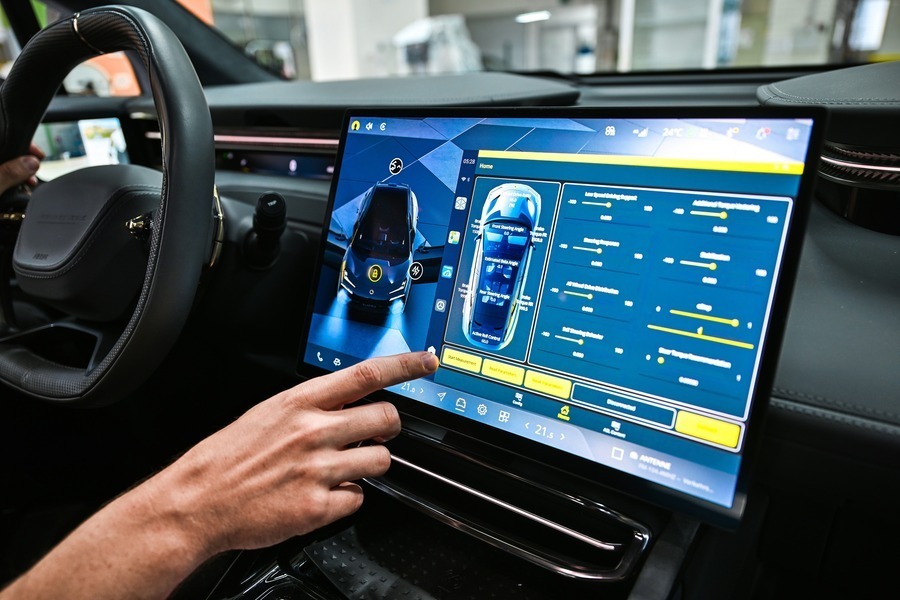
ZF is one of the few technology partners capable of offering hardware-independent software. The company’s cubiX software platform integrates components from different manufacturers to ensure a compatible chassis system. CubiX Tuner automatically calculates the relationships between actuators, allowing brands to easily make adjustments tailored to their own DNA. This allows engineers to shorten complex calibration processes and save development time.
Smart Chassis Sensor and Chassis Health Concept
One example of ZF’s hardware and software integration is the Smart Chassis Sensor, integrated into the ball joint. This sensor, which measures vehicle body movement, can control key chassis functions and entered mass production on the Cadillac CELESTIQ model in 2024.
This sensor continuously records acceleration data as part of the “Chassis Health” concept, calculating the effect of forces on chassis performance in real time. Data transmitted via the cloud is analyzed by AI-powered algorithms to provide critical information about the vehicle’s mechanical condition. This reduces unforeseen breakdowns and optimizes maintenance processes.



