

Couplings&U Joints
Metal bellows coupling KM: Reliable and cost-effective

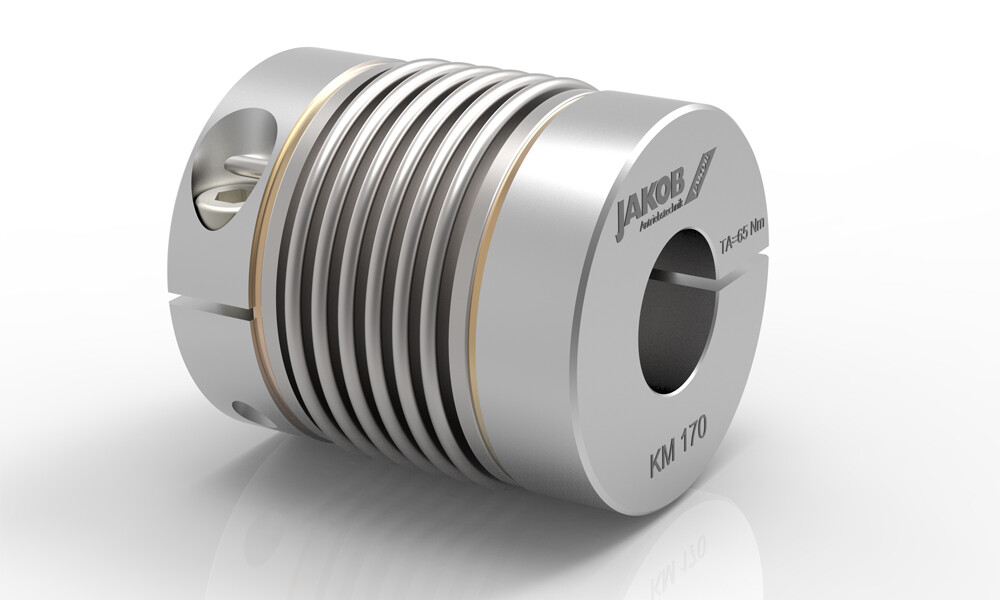
It has proven itself on the market for decades as a reliable and cost-effective standard series of metal bellows couplings: the KM metal bellows coupling from JAKOB Antriebstechnik. Like all metal bellows couplings, it is rigid in the direction of rotation but flexible in the axial, angular, and radial directions. Despite these similarities, metal bellows couplings can differ significantly from one another. The technical differences lie, for example, in the choice of bellows or the type of connection between bellows and hub or bellows and shaft. JAKOB uses only thin-walled, multi-layer bellows made of certified stainless steel sheets. This results in high torsional stiffness. This ensures high positioning and concentricity accuracy even under difficult conditions, guaranteeing absolutely backlash-free torque transmission between the input and output shafts. The multi-layer bellows design also enables the absorption of large shaft displacements while still maintaining low restoring forces. This increases reliability, operational safety, and service life.
The KM clamping hub is equipped with the innovative Easy-Clamp system, which allows for easy installation with sufficient clearance. The preload required for torque transmission is ensured by a single, radially accessible screw per hub. This simple and reliable connection allows for uncomplicated installation in just a few steps, even in confined spaces. To achieve the lowest possible moment of inertia, the hubs are made of high-strength aluminum.
The bellows and hub are connected using a backlash-free press-fit flange joint. Unlike adhesive joints, this joining method offers unlimited fatigue strength under critical operating conditions (-40°C to +200°C, chemicals, etc.) and can safely transmit the transmission torque of each bellows layer to the hub.
